
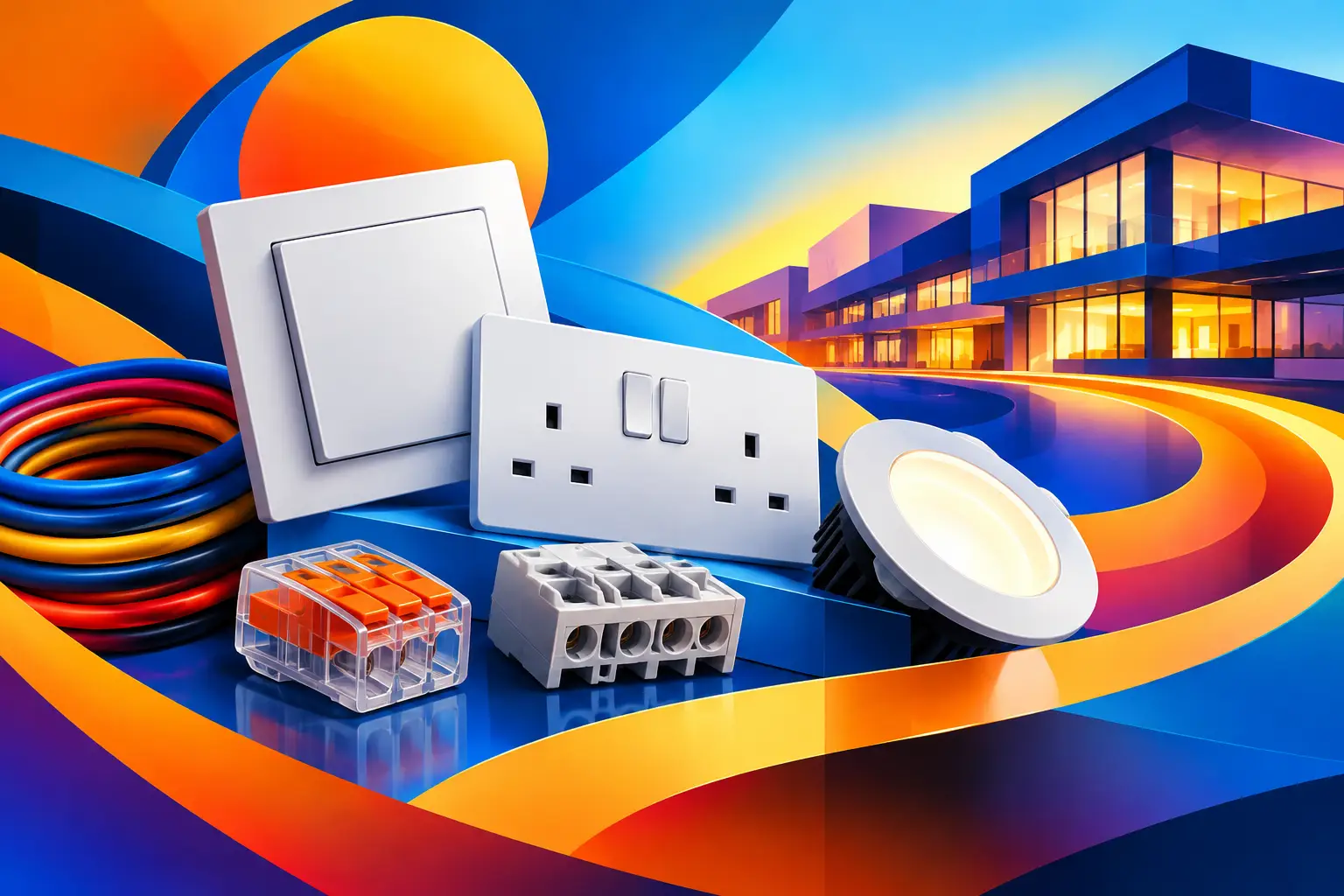
A failed socket outlet, loose connection, or incompatible mounting box can create a disproportionate cost long after project handover. Wiring accessories are often a small line item against the value of a tower, hospital, hotel, or industrial facility, yet they sit at every user touchpoint of the electrical installation. Their selection directly affects safety, appearance, maintenance access, occupant experience, and lifecycle performance.
For procurement teams, MEP consultants, and electrical contractors, the objective is not simply to source switches and socket outlets at the right price. It is to specify a coordinated accessory system that meets applicable standards, fits the installation method, remains available through project phases, and performs consistently across thousands of points.
What falls under wiring accessories?
Wiring accessories are the final-interface and connection components that make an electrical distribution system usable, accessible, and maintainable. They commonly include switches, socket outlets, plugs, connection units, dimmers, fan regulators, data and communication outlets, plates, floor boxes, metal boxes, junction boxes, and associated mounting components.
On a large project, these products must operate as a system. A premium faceplate cannot compensate for a poorly matched back box. A correctly rated socket outlet can still become a failure point if terminal capacity, conductor entry, fixing centers, or enclosure depth do not suit the site installation. The right specification therefore starts with the complete assembly, not an isolated catalog item.
This matters particularly in mixed-use developments, where residential units, retail spaces, hospitality areas, plant rooms, offices, and public corridors may require different accessory ranges but still benefit from coordinated dimensions, finishes, and installation practices.
Specify for the operating environment, not just the drawing
A wiring-accessory schedule should reflect how each space will be used over its full operating life. The same white molded switch that is suitable for a standard apartment may not be the right choice for a wet service area, a high-traffic public facility, or an exposed industrial location.
Environmental exposure is the first filter. Temperature, humidity, dust, UV exposure, cleaning chemicals, vibration, and corrosion risk all influence material and enclosure choices. In coastal GCC locations, for example, corrosion resistance and material stability deserve closer attention. In kitchens, washrooms, external areas, and technical rooms, ingress protection requirements must be aligned with the actual risk, not applied as a generic project-wide assumption.
Usage intensity is equally important. Guest rooms, classrooms, offices, and residences have different operating patterns from airports, hospitals, retail centers, and transport facilities. High-use areas may justify products with enhanced mechanical durability, stronger fixing arrangements, and finishes that retain appearance after repeated cleaning and contact.
Aesthetic requirements also need disciplined control. Developers often want a consistent visual language across public and private spaces, but design intent should not override maintainability. Standardized plate dimensions, replaceable modules, available spare parts, and clear product identification make future repairs faster and reduce the risk of mismatched replacements.
Compliance must be traceable
For professional buyers, compliance is not a marketing statement. It is evidence that must be reviewed against the project specification, authority requirements, and installation standards. Relevant IEC and BS standards may apply depending on the product category and market, while local authority approvals and consultant requirements can add further conditions.
The procurement process should request current test reports, declarations of conformity, technical datasheets, and quality documentation early enough to resolve gaps before materials reach site. This is especially necessary where accessories are specified alongside low-voltage distribution products, data outlets, floor boxes, or specialized enclosure systems.
Certification alone does not remove the need for technical review. Confirm the rated voltage and current, terminal design, conductor acceptance range, earth continuity provisions, flammability performance, IP rating where applicable, and compatibility with the selected box and wiring method. For socket outlets and switches, shutter arrangements, contact quality, switching endurance, and mounting integrity can be significant factors in demanding applications.
Consultants should also avoid vague descriptions such as “approved equivalent” where appearance, dimensions, or performance criteria are critical. A controlled submittal process protects design consistency and reduces substitutions that can complicate installation or future maintenance.
Standardization reduces project risk
Large developments gain real value from reducing unnecessary variation. A standardized family of wiring accessories simplifies approvals, installation training, stockholding, replacement, and defect management. It also allows contractors to plan labor more accurately when installation details repeat across floors, rooms, or buildings.
Standardization does not mean one product everywhere. It means establishing a logical hierarchy: a core range for general areas, higher-protection products for wet or exposed zones, heavy-duty solutions for service spaces, and coordinated data or floor-access products where required. Each range should share clear installation logic and be available in the quantities demanded by the construction program.
This approach is particularly effective for developers managing multiple assets. A consistent accessory specification across residential, hospitality, education, and commercial projects can improve operating familiarity for facility teams while preserving the flexibility to suit each building type.
Supply continuity is a technical requirement
An accessory range can be fully compliant and competitively priced yet still create project pressure if supply is fragmented. Construction schedules rarely require all accessories at one time. Rough-in boxes may be needed early, followed by mechanisms, plates, specialized outlets, replacement quantities, and phased deliveries tied to fit-out completion.
Procurement teams should assess manufacturing capacity, stock planning, lead times for nonstandard finishes, regional warehousing, packaging accuracy, and the supplier’s ability to manage call-off schedules. The cost of a delayed handover due to missing faceplates or a late batch of floor boxes can exceed the value of the materials themselves.
For projects with a long program, agree on product continuity from the outset. Ask whether the selected series is an established range, how design changes are managed, and whether spares will remain available after completion. This is not only a commercial question. It determines whether the facility can maintain a uniform, safe installation years later.
A capable supplier should also coordinate related categories. When boxes, cable-management products, data-distribution components, and accessory plates are sourced with a clear compatibility strategy, site teams spend less time resolving fitment issues between products from separate vendors.
Installation quality determines final performance
Even the best accessory can fail prematurely when installed without control. Site supervision should verify box alignment, wall-finish tolerances, conductor stripping length, terminal tightening, earth connections, device orientation, and plate seating. Accessories installed on uneven surfaces or forced into shallow boxes are more likely to loosen, crack, or develop poor connections.
Mock-up rooms are useful before mass installation, particularly in hotels, premium residences, healthcare facilities, and projects with decorative finishes. They allow the team to inspect plate alignment, module combinations, accessibility, labeling, and the relationship between accessories and surrounding finishes. A mock-up also confirms that the intended product remains practical for electricians to install repeatedly at production speed.
Before energization, inspection and testing should confirm continuity, polarity, insulation resistance, functional switching, and correct operation of protective devices where integrated. Defect reporting should distinguish between product issues, handling damage, and installation errors. That distinction supports a faster corrective response and better quality control across subsequent areas.
A procurement checklist for wiring accessories
Before releasing a purchase order, project teams should confirm that the proposed range meets the following requirements:
- Applicable IEC, BS, local authority, consultant, and project-specification requirements
- Correct electrical ratings, environmental protection, material performance, and terminal capacity
- Compatibility with selected back boxes, floor boxes, conduits, trunking, and cable sizes
- Consistent finishes and module configurations across relevant building zones
- Verified manufacturing capacity, delivery planning, and availability of project spares
- Complete submittal documentation, traceable batch control, and inspection support
The checklist should be applied early, when changes remain manageable. Once wall finishes, joinery, and final fit-out are progressing, a late accessory substitution can affect cost, appearance, labor, and handover dates at the same time.
Build the accessory package around lifecycle value
The lowest unit price is not automatically the lowest installed cost. A better assessment considers approval time, installation productivity, defect exposure, replacement availability, maintenance requirements, and the supplier’s ability to deliver consistent batches across the project schedule.
For major developments and infrastructure programs, this favors manufacturers that combine standards-tested products with broad portfolio depth and organized project supply. Kingston Holdings, through its REXTON portfolio, supports this requirement with integrated electrical product categories, high-volume manufacturing capability, and distribution reach across international markets.
The strongest wiring-accessory specification is one that remains dependable after the construction team has left site. When the product system, installation method, compliance evidence, and supply plan are aligned from the beginning, every switch, outlet, box, and plate becomes a small but reliable part of a building built to perform for years.